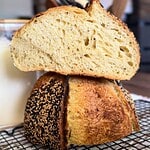
Italian Semolina Sourdough Bread
Jump to VideoSemolina is usually known as the flour used for pasta, but it also makes wonderful bread. It gives sourdough a beautiful golden color, a slightly sweet flavor, and a crust that gets wonderfully crisp when toasted. What I like about this loaf is that it feels a little different from everyday sourdough without adding any extra difficulty. It's an easy way to change up your baking routine, and it works just as well for sandwiches as it does alongside soups, salads, or a simple plate of olive oil for dipping.
PIN THIS RECIPE!
Ingredients
- 300 g bread flour
- 200 g semolina flour fine, semola rimacinata
- 350 g water
- 100 g active sourdough starter
- 10 g salt
- 10 g olive oil
- 50 g sesame seed light, black, or a mix of both
Instructions
- In a large mixing bowl, combine 360g of water, 100g of starter, 10g of olive oil, 10g of salt, 300g of bread flour, and 200g of fine semolina flour. Mix until no dry flour remains. I usually do this with wet hands, squeezing and mixing the dough until the starter disappears and the dough starts to feel smoother, altogether about 3 minutes. The dough will look shaggy and rough at this stage. Cover the bowl and let it rest for 30 to 60 minutes.
- Cover the bowl and let the dough rest for 30 minutes. Perform your first set of stretch and folds by grabbing one side of the dough, stretching it upward, and folding it over itself. Rotate the bowl and repeat until all sides have been folded. Repeat this process two more times, spacing each set about 30 minutes apart.
- Cover the bowl and let the dough continue fermenting at room temperature until it becomes puffy and airy. This usually takes about 5 to 8 hours from the time you added the starter, depending on the temperature of your kitchen. The dough should look noticeably risen and have bubbles forming along the sides of the bowl, but it will not puff up as much as a regular sourdough would.
- Spread a generous layer of sesame seeds onto a large plate. Turn the dough onto a lightly floured work surface and shape it into a round or oval loaf. Once shaped, brush the top of the loaf with wet hands to make the dough wet. Then gently lift the loaf and place it seam-side up onto the sesame seeds. Roll and rock it back and forth until the entire outside surface is evenly coated. Transfer the dough to a floured banneton basket with the seam facing up and the sesame-coated side facing down.
- Cover the dough and refrigerate overnight, or for 8 to 16 hours.
- Preheat your oven to 475°F (245°C) with a Dutch oven inside. Turn the dough onto a piece of parchment paper and score the top with a sharp blade. Carefully transfer the dough into the hot Dutch oven. Bake covered for 20 minutes. Remove the lid, reduce the temperature to 450°F (230°C), and bake for another 20 to 25 minutes, or until the loaf is deeply golden brown.
- Transfer the bread to a wire rack and allow it to cool completely before slicing.
Video
Tried this recipe?Please consider Leaving a Review!
Nutrition
Serving: 1g | Calories: 2122kcal | Carbohydrates: 407g | Protein: 69g | Fat: 19g | Saturated Fat: 3g | Polyunsaturated Fat: 5g | Monounsaturated Fat: 8g | Sodium: 4150mg | Potassium: 734mg | Fiber: 17g | Sugar: 5g | Vitamin A: 7IU | Vitamin C: 1mg | Calcium: 164mg | Iron: 13mg
