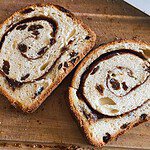
Sourdough Cinnamon Raisin Swirl Bread (The Simplest Version)
You need to make this sourdough cinnamon raisin swirl bread if something sweeter for weekend mornings, but still practical enough to not make a big deal about it. After a lot of testing, this version proved itself to be the one I kept coming back to. The crumb stays soft for days, the swirl actually holds together when sliced, and the cinnamon-raisin flavor tastes just sweet enough, so you don't need to put anything else on it if you don't have time to.
PIN THIS RECIPE!
Ingredients
- 500 g bread flour
- 370 g milk
- 80 g active sourdough starter
- 50 g sugar
- 40 g butter softened
- 8 g salt
- 100 g raisins
- 60 g brown sugar about 5 tbsp, packed
- 10 g flour about 1 tbsp
- 10 g cinnamon about 1 to 1½ tbsp
- 25 g butter softened (about 1¾ tbsp)
Instructions
- Mix all the dough ingredients (except for the raisins!) until combined. Knead just until the dough comes together into a smooth mass (or almost). You’re not trying to reach a full windowpane here; the goal is simply to incorporate everything and get a bit of gluten development started. The dough should feel soft and sticky, and you might wonder if it’s too wet. Don’t be tempted to add any flour at this stage, because the raisins will pull some of the moisture from the dough and it will end up becoming stiffer later. Add raisins at the end and mix just until evenly distributed.
- Cover and let rise until about 30–50% bigger, not doubled. This usually takes about 5–8 hours, depending on your kitchen and starter strength.
- Turn the dough onto a lightly floured surface. Roll into a rectangle (about 25 × 40 cm). This will depend on the loaf pan you’re using. In any case, go almost as wide as your loaf pan is long, almost! Spread the softened butter over the surface. Mix sugar, cinnamon, and flour, then sprinkle evenly. Push the filling all the way to the bottom edge and leave a small clean edge at the top. Roll tightly into a log. Place into a greased 9×5 pan (or a 9x4 pan for a taller loaf)
- Cover and let rise until the dough reaches the top of the pan. This usually takes about 2–4 hours, depending on your kitchen: Warmer kitchen → closer to 2 hours; Cooler kitchen → closer to 4 hours. Don’t let it rise much higher than the rim; that’s when the swirl can start to separate. If you’re unsure, it’s better to bake it a little early than too late.
- Bake: Option 1: Two-pan method (your usual): Preheat oven to 220°C. Place a second loaf pan upside down on top. Bake 45 minutes covered. Remove top pan and bake another 10 minutes uncovered. Option 2: Without two-pan method: Preheat oven to 190°C. Bake 40–45 minutes. If the top starts browning too quickly, loosely cover with foil for the last 10–15 minutes. The loaf should be deeply golden and feel light for its size.
- Optional: Brush with butter while still hot. Let it cool completely before slicing: this is what gives you clean, defined swirls.
Notes
- Add flour to the filling
This keeps the swirl from melting into the dough and gives you visible layers. - Roll tighter than you think
A loose roll leads to gaps and separation. A tight roll gives you that clean spiral. - Slightly underproof is better than overproof
Overproofed dough tends to pull apart around the swirl. - Leave a clean edge when rolling
That helps seal the loaf so it doesn’t unravel. - Don’t overload the filling
Too much filling will leak and blur the swirl. - Pop large air bubbles when rolling
This prevents big holes in your final slice. - Cool completely before slicing
Warm slicing = smeared swirl. - Mix raisins into the dough, not the filling
Otherwise they fall out when slicing.
Tried this recipe?Please consider Leaving a Review!
Nutrition
Serving: 1g | Calories: 3343kcal | Carbohydrates: 598g | Protein: 79g | Fat: 74g | Saturated Fat: 42g | Polyunsaturated Fat: 6g | Monounsaturated Fat: 17g | Trans Fat: 2g | Cholesterol: 184mg | Sodium: 3717mg | Potassium: 2031mg | Fiber: 25g | Sugar: 128g | Vitamin A: 2263IU | Vitamin C: 6mg | Calcium: 728mg | Iron: 9mg
