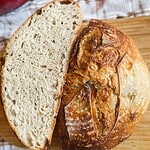
Buckwheat Sourdough Bread (With Simple Buckwheat Scald)
Jump to VideoThis is a simple buckwheat sourdough that stays soft, slices well, and fits into everyday baking. The buckwheat is scalded first, which keeps the crumb tender, balances the flavor, and helps the bread stay fresh longer. No complicated steps, just a reliable loaf that works for real life.
PIN THIS RECIPE!
Ingredients
Buckwheat scald
- 80 grams buckwheat flour
- 160 grams water boiling
Dough
- 360 grams all-purpose or bread flour
- 260 grams water plus extra if needed
- 120 grams active sourdough starter
- 8 grams salt
Instructions
- Place the buckwheat flour in a heatproof bowl. Pour boiling water over it and stir until thick and smooth. Cover and let cool completely.
- In a large bowl, combine the water, sourdough starter, and salt. Add the cooled buckwheat scald and mix well. Add the flour and mix until no dry spots remain. I usually start with a spoon and finish with my hands. Cover and let rest for 30 minutes.
- After 30 minutes, perform your first set of stretch and folds: grab one edge of the dough, stretch it up, and fold it over. Rotate the bowl and repeat 3 more times. Cover and rest 20 minutes. Repeat until you’ve done 4 total sets of stretch and folds.
- Cover the dough and let rise at room temperature for about 4–6 hours, or until slightly domed and about 50% bigger in volume.
- Transfer dough to a lightly floured surface and gently shape into a round chape. Place dough seam-side up into a towel-lined banneton basket or a glass bowl. Cover and refrigerate overnight (8–16 hours).
- Preheat your oven with the dutch oven inside to 450°F (230°C). Turn dough out onto parchment paper, score the top, and carefully transfer into the hot dutch oven.
- Bake covered for 20 minutes. Remove lid and bake another 20–25 minutes until deep golden brown.
- Transfer bread to a cooling rack and let cool completely before slicing.
Video
Notes
- This is a mixed-flour loaf, not gluten-free. Buckwheat has no gluten, so wheat flour is needed for structure.
- If your dough feels stiff, add a splash more water. Buckwheat absorbs more moisture than wheat.
- The flavor improves the next day, and this loaf makes excellent toast.
- You can add seeds during the last set of stretch and folds if you’d like a seeded version.
Tried this recipe?Please consider Leaving a Review!
Nutrition
Serving: 1g | Calories: 1688kcal | Carbohydrates: 354g | Protein: 50g | Fat: 6g | Saturated Fat: 1g | Polyunsaturated Fat: 2g | Monounsaturated Fat: 1g | Sodium: 3139mg | Potassium: 847mg | Fiber: 19g | Sugar: 3g | Calcium: 101mg | Iron: 20mg
