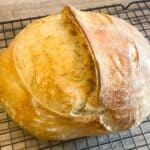
Extra Sour Sourdough Bread Recipe Using Citric Acid
While traditional methods of sourdough baking rely on long fermentation times and even cold fermentation to enhance sourness, they don't always guarantee that extra tangy punch some of us crave in sourdough. Here's the secret: citric acid.
PIN THIS RECIPE!
Ingredients
- 120 grams active sourdough starter ½ cup
- 200 grams warm water roughly ¾ cup + 1½ tablespoons
- 300 grams all-purpose flour 2½ cups
- 6 grams salt 1 teaspoon
- 2.5 grams citric acid ½ teaspoon
Instructions
- In a large bowl, mix the active starter with warm water, salt, and citric acid. Gradually add flour, forming a shaggy dough. Let it rest for 30 minutes.
- Let the dough rest in a covered bowl at room temperature for its first rise, allowing for bulk fermentation. This can take anywhere from 6 - 8 hours, depending on the temperature in your kitchen.
- In the first hour of bulk fermentation, do 4 sets of stretch and folds, approximately 20 minutes apart.
- To perform the stretch and folds, start by gently grasping the edge of your dough. Pull it upwards, then fold it across to the opposite side. After this step, give your bowl a quarter turn. Continue this process for three more turns. This makes one round of stretch and folds! After stretch and folds, you should have a smooth dough to work with.
- Once the bulk fermentation is done, move your bread dough to a floured work surface and shape it: Fold the edge of the dough to the center, turn it a bit, and fold the next edge. Keep turning and folding until you've gone full circle. Turn the dough over so the seam faces the counter. Then shape the dough into a round ball with your hands. Place it gently in a proofing basket.
- Use something airtight (a plastic bag or a plastic wrap) to prevent the dough from drying out during the second rise.
- For the second proof, choose one of two options:Same day: Let the shaped dough rise at room temperature for about 2 hours, or until it looks puffy. It does not need to double in size.Overnight: Cover the shaped dough and refrigerate it for up to 24 hours. Bake it the next day.
- After your dough has risen a bit and your oven is ready, get a parchment paper. Carefully move the dough from the basket to the paper with the seam facing down.
- Use a razor blade or a sharp knife for deep horizontal slashes, ensuring that the crust will open only where you scored the bread. Scoring allows carbon dioxide to escape.
- Put the dough with its paper into the preheated Dutch oven.
- If you want more bubbles to make some nice crust on your bread, pour some water between the paper and Dutch oven for steam, then quickly cover it.
- Bake the bread in an oven set to 460°F (238°C) for 35 minutes. Then, take off the lid and bake for another 12-15 minutes at 440°F (227°C) until it turns a nice golden brown color.
- Once out of the oven, transfer the bread to a cooling rack. Drape a mildly wet cloth over it and wait for at least an hour before cutting.
Notes
- For a little more sour flavor, you can extend the cold proof for up to 3 days. I tested this method and found that the longer cold proof made the bread slightly more sour. This is optional; for the standard overnight version, refrigerate the shaped dough for up to 24 hours.
- Ensure your sourdough starter is active. It's crucial for the dough's good rise.
- To stop the dough from sticking, handle it with wet hands. The dough might feel sticky at first, but wet hands help.
- You can use olive oil to coat the bowl you are raising your bread in to avoid the dough from sticking.
- Let the dough rise fully for good bread.
- For easier scoring, you can keep the dough in the fridge overnight. The dough temperature matters in this case since cold dough is easier to cut.
- Don't use very hot water; it can harm the yeast.
- Look at the dough, not the clock how the dough feels and looks tells you when to move to the next step. Towards the end of the rising time, keep a close eye on your dough.
- Wait for the bread to cool for about an hour before cutting. Cutting it early can make the inside gummy.
Tried this recipe?Please consider Leaving a Review!
Nutrition
Serving: 1slice | Calories: 101kcal | Carbohydrates: 21g | Protein: 3g | Fat: 0.3g | Saturated Fat: 0.04g | Polyunsaturated Fat: 0.1g | Monounsaturated Fat: 0.02g | Sodium: 195mg | Potassium: 27mg | Fiber: 1g | Sugar: 0.1g | Calcium: 4mg | Iron: 1mg
