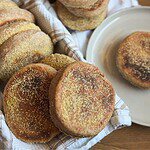
Fresh Milled Sourdough English Muffins (Same Day or Overnight)
These fresh milled sourdough English muffins are soft, chewy, and full of classic nooks and crannies. Made with fresh-milled hard wheat flour and an active sourdough starter, they're cooked right on the skillet and are delicious toasted with butter, jam, or honey.
PIN THIS RECIPE!
Ingredients
- 500 g fresh-milled hard white wheat flour
- 375 g whole milk plus 10–30 g more as needed
- 120 g active sourdough starter 100% hydration
- 20 g granulated sugar
- 30 g unsalted butter melted
- 10 g salt
- Cornmeal semolina, or rice flour for dusting
Instructions
- Mix and rest. Add the fresh-milled flour, 350 g milk, sourdough starter, sugar, melted butter, and salt to a large bowl. Mix until no dry flour remains. Cover and let the dough rest for 30 minutes to give the fresh flour time to hydrate. After resting, check the consistency and add more milk a little at a time if needed. The dough should be very soft and tacky.
- Develop the dough. Do 2 sets of stretch and folds about 20–30 minutes apart. You don't need to develop a windowpane, but the dough should become smoother, stronger, and better able to hold its shape after you’ve done with handling it.
- Bulk ferment. Cover the bowl and leave the dough at room temperature for about 6 hours (it can take anywhere from 4-8, depending on your kitchen’s temperature!), or until it looks puffy and has increased in volume by roughly 50%. Don't wait for it to fully double. I recommend using a glass bowl to proof the dough in, so you’ll be able to see when it’s full of bubbles.
- Cut and proof. Turn the dough onto a floured surface and gently pat or roll it to about ¾ inch (2 cm) thick. Cut out rounds with a 3–3½-inch (7-9 cm) biscuit cutter (I’m using a 8 cm one). I usualy cut out 6, roll the dough again, than do 4, roll again, and cut out the last 2.
- Place the pieces into a parchment paper lined baking pan sprinkled with cornmeal or semolina, sprinkle some on top, and cover with a plastic wrap or a damp kitchen towel. Let them proof for about 2 hours (this is a flexible time, I make sure to do at least 1 and no more than 3) hey I wish I, until they look puffy.
- Cook. Preheat a skillet or griddle over low to medium-low heat. Place the muffins on the hot surface, leaving room between them, and cook for about 6–8 minutes per side. Keep the heat relatively low so the centers have time to cook before the outsides get too dark. The centers should reach about 200°F (93°C).
- Cool and split. Transfer the English muffins to a wire rack and let them cool completely. To get those classic rough edges and nooks and crannies, split them with a fork instead of slicing them with a knife.
Notes
Hard white wheat: My first choice for English muffins. It has enough protein to give the muffins good structure while keeping the whole-wheat flavor relatively mild.
Hard red wheat: Works well too, but gives the muffins a stronger whole-wheat flavor. Start with 385 g milk and add a little more after resting if the dough feels too firm.
Fresh-milled flour can vary quite a bit in how much liquid it absorbs. After the dough rests, it should feel very soft and tacky, not firm like a typical bread dough. Add another 10–30 g milk if needed.
TIMING NOTE: If you’re making these overnight, then you can decrease the starter amount all the way down to about 60, and they’ll be nice and fermented in about 8-20 hours. That way, you can mix the dough in the evening, stretch it once or twice, and make the English muffins in the morning.
Another way is to mix the dough in the middle of the day, shape in the evening, and cold proof shaped anf covered english muffins overnight. That way, you can bake them first thing in the morning and have them fresh for breakfast!
Tried this recipe?Please consider Leaving a Review!
Nutrition
Calories: 52kcal | Carbohydrates: 5g | Protein: 1g | Fat: 3g | Saturated Fat: 2g | Polyunsaturated Fat: 0.1g | Monounsaturated Fat: 1g | Trans Fat: 0.1g | Cholesterol: 9mg | Sodium: 335mg | Potassium: 48mg | Fiber: 0.1g | Sugar: 3g | Vitamin A: 113IU | Calcium: 39mg | Iron: 0.004mg
