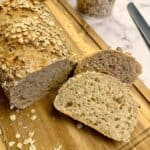
Honey Oat Sourdough Sandwich Loaf
This Honey Oat Sourdough Sandwich Loaf is soft, slightly sweet, and full of homemade goodness. The oats give it a cozy texture, while the honey adds a gentle sweetness that makes every slice perfect for sandwiches or toast. It’s wholesome, golden, and simple to make, a classic loaf that feels just right for everyday baking.
PIN THIS RECIPE!
Ingredients
- 30 g rolled oats
- 95 g milk
- 290 g all-purpose flour
- 60 g whole wheat flour 350 g total flour
- 190 g water
- 80 g active sourdough starter
- 15 g olive oil
- 25 g honey or 20 g granulated sugar
- 8 g salt
Instructions
- Add oats and milk to a small saucepan. Bring to a gentle simmer over medium-low. Let it simmer 1–2 minutes, cover, turn off heat, and set aside to cool slightly.
- In the bowl of a stand mixer, add all ingredients, flours, water, starter, oil, honey (or sugar), salt, and the cooked oat mixture.
- Mix on medium speed ~5 minutes until a cohesive dough forms. The goal here is not gluten development, flour isn’t fully hydrated yet.
- Move the dough to the bowl where you’ll bulk ferment and do stretch-and-folds. Cover and rest 30 minutes.
- Perform 2–3 sets of stretch-and-folds every 30 minutes after the 30-minute rest in step (4).
- Let the dough bulk ferment based on dough temp and visible signs. In warm conditions it may take ~5 hours; in cooler conditions closer to ~9 hours. Dough should be airy, soft to the touch, and risen in volume.
- Turn the dough onto the counter, placing the former top side down so it’s less sticky. I usually skip flour, but if it feels tacky, dust the surface lightly.
- Gently stretch the dough into a rectangle, then roll it into a log.
- Mist the surface with water, roll the log in rolled oats, and set it seam-side down in a parchment-lined 9×5-inch pan. Cover with a damp tea towel, plastic bag, or a shower cap.
- Let the shaped loaf proof at room temperature for about 2–3 hours until puffy and well-risen, or cover and refrigerate to cold proof; if cold-proofed, finish the second rise at room temperature before baking. *if you’re in a hurry, skip the second rise altogether, and you’ll still get a result that’s 95% perfect!
- Just before baking, score the loaf, you can score any way you like, but I prefer three diagonal scores on this bread.
- Bake at 400°F (204°C): For a standard bake, bake 40-45 minutes until the crust is nicely golden and the center reads 200–205°F (93–96°C); if browning fast, reduce to 375°F (190°C) for the last 10 minutes. Covered-then-uncovered option (using two pan method!): place an inverted 9×5 loaf pan over the dough for the first 35 minutes at 400°F (204°C) to trap steam, then remove the cover and bake 20-25 minutes more, until golden and 200–205°F (93–96°C) internal; if needed, finish at 375°F (190°C).
- Remove from pan and cool at least 1 hour before slicing.
Notes
- If the oats feel a bit warm, you can use slightly colder water to balance the temperature.
- You don’t have to be too particular about the timing of stretch-and-folds, I suggest two to three sets in the first two to three hours of bulk fermentation, so the dough then has the option to expand in peace.
- If you don’t have a spray bottle to mist water on, lightly wet your fingers and tap the dough so the surface becomes a bit damp, then roll on the rolled oats, that works too.
Substitutions
- You can use melted butter instead of olive oil if you want, but I prefer olive oil here because oils give bread a softer structure, whereas butter gives it a bit richer structure.
- You can decide how much honey or sugar to use. You can use less than the recipe says, for example 10 g honey or 10 g sugar. You can even use no sweeteners, but in that case, prolong the bulk fermentation by about an hour.
Tried this recipe?Please consider Leaving a Review!
Nutrition
Serving: 1g | Calories: 1712kcal | Carbohydrates: 325g | Protein: 47g | Fat: 25g | Saturated Fat: 5g | Polyunsaturated Fat: 4g | Monounsaturated Fat: 13g | Cholesterol: 11mg | Sodium: 3157mg | Potassium: 793mg | Fiber: 18g | Sugar: 26g | Vitamin A: 159IU | Vitamin C: 0.1mg | Calcium: 206mg | Iron: 17mg
