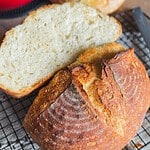
Hybrid Sourdough Bread (With Yeast)
If you’ve ever wanted the flavor of sourdough without the stress or unpredictability, this hybrid sourdough bread (with yeast) is exactly what you need. It still gives you classic sourdough flavor and airy crumb, but with a little yeast to make the process more reliable and beginner-friendly. This is the loaf I recommend when you want consistent results without the stress.
PIN THIS RECIPE!
Ingredients
- 400 g all-purpose flour or bread flour
- 280 g water (260g for the dough + 20g for the yeast)
- 8 g active sourdough starter
- 0.5 g dry yeast about ⅛ teaspoon OR
- 1.5 g fresh yeast
Instructions
- In a large bowl, mix together your water (260g of water at this stage!), starter, and salt. I like to mix those first so everything has a chance to disperse evenly before adding the flour. Add the flour and mix well. I usually start with a spoon and then switch to my hands to make sure there are no dry patches left. The dough will feel a bit sticky, and that’s exactly what you want. Try to quickly develop the gluten a bit even at this stage, so try to pull the dough up and tuck it under for a few times to get it in a rough ball shape. Cover the bowl with something airtight (a plastic bag works great) and let it rest for 30 minutes.
- Prepare your yeast. If you're using fresh yeast, mix it with 20g of water and add ½ teaspoon of sugar, then wait for about 10 minutes for it to start foaming a little. If you're using dry yeast, measure it out and prepare 20g of water in a separate bowl (the water will just help it incorporate into the dough better in this case).
- After the dough rests for about 30 minutes, add the yeast - pour the water with fresh yeast inside over the dough, or add yeast + 20g water if you're using dry yeast. Incorporate the yeast into the dough well by squeezing in with your hands. Try to get the dough into a rough ball shape again and cover it for another rest period.
- After 30 minutes, do your first set of stretch and folds. Grab one side of the dough, stretch it up, and fold it over to the other side. Rotate the bowl and repeat until you’ve gone around all sides. Cover again and let it rest for 30 minutes.
- Repeat this process one more time, so you end up doing 2 sets of stretch and folds in total, with 30 minutes of rest in between. By the end, the dough should feel smoother and hold its shape better.
- Once you’re done with stretch and folds, cover the dough again and let it bulk ferment at room temperature. This whole process, including the stretch and folds, should take about 3 hours total. That means you’re looking at roughly 1.5 hours of rising time after your last stretch and fold. If your kitchen is cooler, this can easily go up to 4 hours total.
- After bulk fermentation, turn the dough out onto a lightly floured surface. Gently bring it together into a ball by folding it into itself. Let it rest for about 10–15 minutes.
- Then turn it over, gently stretch it into a rectangle, and shape it. I usually do a simple boule by rolling it up once, then again from the short edge to create some tension.
- Prepare your banneton basket by lining it with a floured kitchen towel (this saves a lot of cleaning later). Place your dough inside with the seam facing up. Cover again and transfer it to the fridge for an overnight proof, or up to about 18 hours.
- Preheat your oven with a Dutch oven inside to 250°C (480°F). Give it at least 30–45 minutes so everything is properly heated. Once ready, turn your dough out onto a piece of parchment paper so the floured bottom is now facing up. Score it with a sharp knife or razor blade.
- Carefully transfer the dough into the hot Dutch oven, cover with the lid, and bake for 20 minutes at 250°C (480°F).
- Then remove the lid, lower the temperature to 220°C (430°F), and bake for another 20–25 minutes, or until nicely golden brown. Transfer the bread to a cooling rack and let it cool completely before slicing.
Notes
- You’ll want to measure your yeast quite carefully here. It’s a very small amount, but it makes a difference.
- If you add more or less yeast, adjust your fermentation times accordingly.
- If you add more yeast, I wouldn’t suggest doing an overnight fridge proof. Instead, let it do a second rise at room temperature for about an hour and bake the same day.
- The dough will feel a bit sticky at first. Try not to add extra flour unless it’s really necessary.
- This is meant to be a simple, reliable dough, so don’t overthink it.
Tried this recipe?Please consider Leaving a Review!
Nutrition
Serving: 1g | Calories: 1470kcal | Carbohydrates: 308g | Protein: 42g | Fat: 4g | Saturated Fat: 1g | Polyunsaturated Fat: 2g | Monounsaturated Fat: 0.4g | Sodium: 23mg | Potassium: 447mg | Fiber: 11g | Sugar: 1g | Calcium: 69mg | Iron: 19mg
