Sourdough Palatschinken (Central European Crepes with Sourdough Discard)
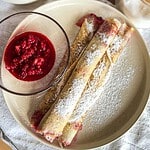
Palatschinken are the Central European version of crepes. If you grew up anywhere around Austria, Slovenia, Hungary, or the Czech Republic, you probably had them filled with jam, chocolate, or sweet cheese. This sourdough version is one of my favorite ways to use up discard. The batter comes together in just a few minutes, and the sourdough adds a little extra flavor without making the crepes taste sour.
PIN THIS RECIPE!
Ingredients
- 480 g milk
- 3 eggs large
- 20 g sugar
- 120 g sourdough starter discard or active
- 160 g all-purpose flour
- ¼ teaspoon salt
- 1 teaspoon vanilla extract optional
- ¼ teaspoon cinnamon optional
- Butter or oil for the pan
Instructions
- In a large mixing bowl, add the milk, eggs, sourdough starter, flour, sugar and salt. If you like, also add the vanilla extract and cinnamon. Both are optional, but they work nicely if you plan to serve the palatschinken with jam or chocolate. Mix everything together using a whisk, hand mixer, or immersion blender until the batter is smooth and most lumps are gone. The batter should be quite thin, similar to heavy cream. If it seems thick, add a splash of milk.
- Some recipes recommend letting the batter rest for 15–30 minutes. Personally, I rarely bother. I usually just mix the batter and start cooking right away.
- Heat a nonstick skillet over medium heat. A good nonstick pan makes palatschinken much easier to cook. I usually use a nonstick skillet, but a well-seasoned cast iron pan can also work. Lightly grease the pan with a little butter or oil.
- Pour about ¼-½ cup of batter into the center of the pan (depending on the size of the pan and how thick you like them). Immediately tilt and swirl the pan so the batter spreads into a thin layer covering the bottom.
- Cook the palatschinken for about 45–60 seconds. You’ll know it’s ready to flip when the edges start lifting slightly and the bottom turns lightly golden.
- Slide a thin spatula under the crepe and flip it. I like using an offset spatula, which slides under the crepe very easily. I often help myself with a cake server (the triangular tool used for serving cake) to support the other side while flipping Cook the second side for another 20–30 seconds. If the crepe feels delicate, using two spatulas can make flipping easier.
- Transfer the finished palatschinken to a plate and continue cooking the rest of the batter. You can stack them directly on top of each other. They stay soft and flexible this way.
Notes
- Starter:
This recipe works with sourdough discard or active starter. I usually use discard. - Pan size:
A 9–10 inch skillet works best for thin palatschinken, but you can make them larger or smaller if you want to. - Color:
Some people prefer very pale crepes, while others like them slightly golden. Both are traditional. - Consistency tip:
The batter should be thin enough to spread easily when you swirl the pan. It should be way more pourable than the batter for American pancakes.
Filling Ideas
Traditional fillings include:- Apricot jam
- Nutella or chocolate spread
- Sweet farmer’s cheese
- Powdered sugar
- Lemon juice and sugar
Tried this recipe?Please consider Leaving a Review!
Nutrition
Serving: 1g | Calories: 84kcal | Carbohydrates: 13g | Protein: 3g | Fat: 2g | Saturated Fat: 1g | Polyunsaturated Fat: 0.2g | Monounsaturated Fat: 1g | Trans Fat: 0.003g | Cholesterol: 37mg | Sodium: 64mg | Potassium: 72mg | Fiber: 0.4g | Sugar: 3g | Vitamin A: 99IU | Vitamin C: 0.001mg | Calcium: 46mg | Iron: 1mg
