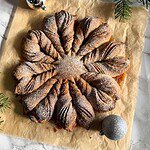
Sourdough Star Bread | 100% Whole Grain (Fresh-Milled Flour)
Jump to VideoThis sourdough star bread is one of those recipes that looks impressive but is very doable if you take it step by step. Made with 100% freshly milled flour, soft layers of cinnamon sugar, and a naturally fermented dough, it’s tender, flavorful, and perfect for sharing!
PIN THIS RECIPE!
Ingredients
Brioche Dough (Fresh-Milled, Sourdough)
- 400 g fresh-milled hard white wheat flour
- 80 g active sourdough starter
- 240 g milk room temperature is ideal
- 64 g sugar
- 56 g butter softened
- 1 egg
- 6 g fine sea salt
Cinnamon Filling
- 60 g butter softened and spreadable
- 90 g sugar half white + half light brown is lovely, but all white works
- 1 tablespoon cinnamon ground
- cardamom Optional: a pinch of cardamom
Finish
- 1 tablespoon egg beaten, for brushing
- Icing sugar for dusting
Instructions
- Add the milk, starter, egg, sugar, flour, butter, and salt to the bowl of your mixer. Using ingredients that aren’t ice-cold helps shorten fermentation slightly, but it isn’t required. You can use ingredients straight from the fridge, just make sure the butter is softened. Knead until the dough is evenly mixed, about 3–5 minutes. Then turn off the mixer.
- Move the dough into a clean bowl. Cover and rest for about 30 minutes, then give the dough a set of stretch-and-folds. Repeat once more after another 30 minutes. Let the dough rise at room temperature until it feels airy and has increased by roughly half. Expect about 6–8 hours depending on your room temperature. If your starter is very active and your kitchen is warm, 5 hours may be enough. See notes for timing advice.
- Once bulk fermentation is done, refrigerate the dough for anywhere from 4 hours to overnight. Cold dough is much easier to roll and cut, and the layers are easier to assemble. One chill period is ideal for brioche since it doesn’t need extra sourness, but it still gets the benefits of long fermentation.
- Stir together the sugar and cinnamon (and cardamom, if using). Keep the butter soft and easy to spread.
- Turn the chilled dough onto a lightly floured counter and divide it into four equal portions. A helpful trick: weigh the dough and divide that number by four for the most accurate pieces. Shape each portion into a loose ball and let them rest for a few minutes.
- Roll the first ball into a circle about 25 cm (10 inches) across. Roll all four balls once, then start again from the first and roll each circle a second time. This short rest helps the gluten relax so the shapes stay even.
- Spread the first circle with a thin, even layer of soft butter, then sprinkle roughly one-third of the cinnamon-sugar mixture over it. Top with the second circle and repeat the butter and sugar. Do the same with the third circle. Finish with the fourth circle on top, leaving it plain. Move everything onto a parchment-lined baking tray. Optional: You can place the whole stack in the fridge for 10–15 minutes to make cleaner cuts.
- Press a small round cutter or glass (about 6 cm / 2 inches) into the center as a guide, but do not cut through. Use a sharp knife to cut the dough into 16 even strips, stopping at the center mark. The easiest method is: cut into quarters → then eighths → then sixteenths. To form the star: Pick up two neighboring strips, twist them away from each other twice, then pinch the ends together (or tuck them under). Continue all around until you have a full star.
- Cover the shaped star and let it proof for 1–4 hours. It should look slightly puffy and softer to the touch. The exact time depends a lot on temperature.
- Preheat the oven to 180°C / 350°F. Optional: Brush the dough lightly with egg wash for shine. Bake for 25–30 minutes, until the star is richly golden. The center should reach about 93°C (200°F). If the surface darkens too quickly, place a piece of foil over the top for the last few minutes.
- Let the star cool for about 15–20 minutes.
- Then dust with icing sugar. It’s best enjoyed warm, when the layers pull apart soft and tender.
Video
Notes
- You can also make this in a stand mixer without stretch and folds: after the initial mix, turn the mixer off for at least 30 minutes (60 minutes is even better) to let the dough hydrate. Then turn it back on and mix for about 15 minutes to develop gluten.
- You can make this star bread with different fillings, such as chocolate or cranberry-orange. Just be careful not to overfill, as too much filling can ruin the shape.
- *The timing of the first rise starts when you add the starter, so in this recipe, it begins when you first mix the ingredients. It doesn’t matter how long you let it hydrate after mixing or when you did the stretch and folds; the bulk fermentation “clock” starts with the addition of the starter.
Tried this recipe?Please consider Leaving a Review!
