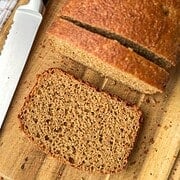
The Easiest Fresh Milled Einkorn Sourdough Bread (Loaf Pan Method)
This 100% fresh-milled einkorn sourdough bread is made with just einkorn flour, water, sourdough starter, and salt. Baking einkorn in a loaf pan makes things a little easier than shaping it into a boule because the pan provides the support that einkorn's fragile gluten structure struggles to create on its own. That also means we can use a little more water while keeping the handling simple.
PIN THIS RECIPE!
Ingredients
- 650 g freshly milled einkorn flour
- 455 g water
- 100 g active sourdough starter 100% hydration
- 14 g salt
- Butter or oil for greasing the loaf pan
Instructions
- Add the freshly milled einkorn flour, 455g water, active sourdough starter, and salt to a large bowl. Mix well until everything is evenly incorporated (you'll most likely need your hands for this!). The dough will be very sticky, and the goal is merely to incorporate everything nicely.Cover and let the dough rest for 30-60 minutes.Don't try to make einkorn dough feel like regular bread-flour sourdough. It won't become as elastic or strong!
- After the 30 minute rest, perform one and only set of “stretch and folds.” Those won't be your typical stretch and folds you're used to with regular sourdough dough, but rather more like rearranging sticky dough a bit. Don't pull the dough aggressively. The goal is not to build strength in the dough, but to evenly and gently give the dough a second mix to ensure even fermentation and add a little bit of elasticity to it.Cover again and leave the dough to continue fermenting.TIP: More stretch and folds aren't necessarily better with einkorn. Einkorn has a much more fragile gluten structure than modern wheat, and excessive handling can actually weaken the dough.
- Cover the dough and leave it to bulk ferment at room temperature for about 5-7 hours.Keep in mind that the time for bulk fermentation starts when you add in your starter, so the 30-minute rest and stretch and folds are included in this time.Instead of following the clock exactly, watch the dough. You're looking for it to become visibly puffy and aerated, with some visible bubbles and approximately 30% growth in volume.Do not wait for the dough to double! Einkorn can go from nicely fermented to overfermented much faster than a strong bread-flour dough.
- Generously (because the dough is supposed to be super sticky!) grease a 9 x 5-inch (23 x 13cm) loaf pan. Heavily flour your working surface.Lightly wet your hands and gently turn out the dough. Shape it into a rough log and transfer it to the prepared loaf pan. I recommend working quickly here: flour will only keep the stickiness at bay for a little, so as soon as you can get the dough into a long and into the loaf pan, just do it. Use wet hands to gently smooth out the top, but keep in mind that the dough will rise and even itself out a lot anyway.
- Cover the loaf pan and leave it to rise for about 1–3 hours.Optionally, you can do an overnight cold fermentation too, by putting the dough into the fridge for up to 12 hours. Again, don’t wait for the dough to double or necessarily rise dramatically above the rim. Einkorn's gluten structure is fragile, and pushing the second rise too far can cause the dough to weaken or collapse.
- Toward the end of the second rise, preheat the oven to 375°F (190°C) (or to 425°F (220°C) if using my two-pan method, see instructions below!)Bake uncovered for about 50–60 minutes, until the loaf is nicely browned and baked through. If the top starts getting too dark before the center is done, loosely cover it with aluminum foil.If you have an instant-read thermometer, aim for an internal temperature of approximately 200–205°F (93–96°C) in the center.Optional: use my two-pan method for a crustier loaf. Preheat the oven to 425°F (220°C). Place a second loaf pan upside down over the pan containing the dough, creating a lid that traps steam around the bread. Bake covered for 45 minutes. Carefully remove the top pan, reduce the oven temperature to 400°F (205°C), and bake uncovered for another 10–20 minutes, until the crust is nicely browned and the center reaches 200–205°F (93–96°C).
- Leave the bread in the pan for about 10 minutes, then remove it and transfer it to a cooling rack.Let it cool completely before slicing, ideally for about 2 hours.This is especially important with fresh-milled einkorn. Cutting into it while it's still hot can leave you with a gummy crumb even when the loaf is properly baked.*NOTES ON THE STARTER AMOUNT: This recipe is (as all sourdough recipes are!) flexible. Sometimes I only have 50g of starter left, so that’s how much I’ll use. Sometimes it’s in my interest to use up a lot. This recipe works best with around 100g of starter (but that’s my opinion!), but you can go higher or lower! Just keep in mind to adjust the bulk fermentation time in case you’re diverging from the recipe’s starter amount.
Notes
Tips for Making 100% Fresh Milled Einkorn Sourdough Bread
Expect a sticky dough.
This dough is wetter than the boule dough, and that's intentional. The loaf pan gives us more freedom with hydration because the dough doesn't have to hold its shape by itself.
Don't chase a windowpane.
You won't get the dramatic thin, stretchy windowpane you'd expect from strong bread flour. That's okay. Einkorn gluten is brittle and behaves differently.
Don't overdo the folds.
One set is plenty. More handling isn't necessarily better with einkorn.
Watch fermentation carefully.
Einkorn will overferment quickly, and once its gluten structure starts breaking down, more fermentation won't give you a lighter loaf. In my experience, it ferments faster than hard white or hard red flour based loaves!
Wet your hands instead of adding flour.
Since we don't need this dough to hold a boule shape, there's no reason to work lots of additional flour into it during shaping.
Don't expect a huge rise.
A 100% fresh-milled einkorn loaf will naturally have a tighter crumb and more modest rise than bread made with strong modern wheat. Expect 30% rise at the most.
Baker's Notes
This is intentionally a simple four-ingredient recipe: freshly milled einkorn, water, sourdough starter, and salt.
The hydration of this loaf is a bit higher than for my einkorn boule recipes, but we can get away with the additional water here because the loaf pan supports the dough during its final rise and baking.
Use your first loaf as a baseline. If the crumb seems too tight and the dough handled the hydration easily, try adding a little more water next time. If the loaf feels overly wet, weak, or collapses, decrease the water, shorten fermentation, or both.
Tried this recipe?Please consider Leaving a Review!
Nutrition
Calories: 8kcal | Carbohydrates: 2g | Protein: 0.2g | Fat: 0.02g | Sodium: 454mg | Potassium: 0.1mg | Fiber: 0.1g | Calcium: 1mg | Iron: 0.004mg
