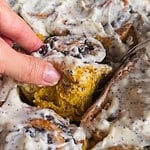
Fresh Milled Pumpkin Sourdough Rolls with Poppy Seed Filling
These Fresh Milled Pumpkin Sourdough Rolls are soft, lightly sweet rolls filled with a homemade poppy seed filling and topped with creamy vanilla cream cheese frosting. They’re great to bring to a Halloween gatherings, or to just enjoy in fall for breakfast or brunch.
PIN THIS RECIPE!
Equipment
- 1 9 × 13 inch / 23 × 33 cm Pan
Ingredients
Pumpkin Sourdough Dough
- 500 g freshly milled hard white wheat flour
- 150 g roasted Hokkaido pumpkin cooled (or any kind of pumpkin puree)
- 170 g whole milk plus up to 80g more if needed
- 100 g active sourdough starter
- 80 g sugar
- 70 g unsalted butter melted and cooled or softened
- 1 large egg
- 7 g salt
- ½ teaspoon cumin powder
Poppy Seed Filling
- 100 g ground poppy seeds
- 200 g whole milk
- 40 g butter
- 60 g sugar
- 1 large egg
- 12–15 g breadcrumbs about 1 generous tablespoon
Vanilla Cream Cheese Frosting
- 115 g cream cheese softened
- 30 g unsalted butter softened
- 70–90 g powdered sugar
- 1 teaspoon vanilla extract
- 1–2 tablespoons milk as needed*
- ½ tablespoon poppy seeds
- Small pinch of salt
Instructions
- Mix ALL the ingredients together.Blend 170g of milk and ½ teaspoon of cumin powder with roasted pumpkin chunks. Melt the butter (softened butter is alright too if you have it on hand). In a large bowl or stand mixer, combine the milk-cumin-pumkin purée, butter (melted but cooled, or very soft), flour, sourdough starter, egg, sugar, and salt. Mix again until no dry flour remains (about 5 minutes by hand or about 3 minutes with a stand mixer).
- Add the milk and rest. If the dough is very dry and stiff, start adding in milk. The amount of milk you’ll need to add will depend on the kind of pumpkin you roasted or the kind of pumpkin puree you’re using. If you’re using canned pumpkin puree it’s possible you’ll only need 10 g or 20 g of milk. With firm roasted Hokkaido pumpkin chunks for example, I usually need to add 80 g. What you’re looking to achieve here is a dough that is similar in consistency to fresh milled brioche dough - quite stiff at this point, but with no dry flour, and since it hasn’t rested yet, it’ll look tacky and unmanageable. That’s fine! Let the dough rest for about 30 minutes.
- Stretch and folds.Perform 2–3 sets of stretch and folds about 30 minutes apart.
- Bulk ferment.Let the dough rise until it has increased by about 30% in volume, usually 5–7 hours at around 22°C / 72°F. You can also refrigerate the dough overnight after bulk fermentation and continue the next day (in that case, the end result will be a tad more sour).
- Make the poppy seed filling.Add the poppy seeds and 200 g milk to a saucepan. Bring to a gentle boil, then simmer over medium-low heat for about 5 minutes, stirring frequently, because the poppy seeds will soak up the milk. Remove from the heat and stir in the butter, sugar, and breadcrumbs.
- Cool and finish the filling.Let the filling cool completely or until barely lukewarm, then stir in the egg. The filling should be thick and spreadable. If it seems too loose, add another 5–10 g breadcrumbs.
- Shape the rolls.Lightly flour your work surface and roll the dough into a 12 × 18 inch / 30 × 45 cm rectangle. Spread the poppy seed filling evenly over the dough. Cut into 12 strips along the long edge, roll each strip into a spiral, and place in a greased 9 × 13 inch / 23 × 33 cm baking dish.
- Final proof.For a same-day bake, cover and let the rolls proof at room temperature until visibly puffy, usually 2–3 hours. For an overnight option, refrigerate the shaped rolls, then bring them to room temperature the next day and let them proof until puffy, usually 3–4 hours.
- Bake.For a convection / fan oven, bake at 180°C / 355°F for 22–27 minutes. For a conventional oven, bake at 190°C / 375°F for 25–30 minutes. Tent loosely with foil if the tops brown too quickly. Let the rolls cool for 10–15 minutes before serving.
- Make the frosting and finish. Beat the cream cheese and butter until smooth. Add 70 g powdered sugar, vanilla, and a pinch of salt. Beat until creamy, then add milk a little at a time until the frosting is soft and easily spreadable. Add ½ tablespoon poppy seeds. Taste and add up to another 20 g powdered sugar if you want it sweeter. Spread over the rolls while they're still slightly warm.
Notes
- You can use from 50g to 150g of starter in this recipe, just make sure to adjust the fermentation time in case of using any more or less than 100g.
- As you can see from the recipe, you can technically refrigerate the dough before shaping and then after shaping again. That’ll work fine, but since every refrigeration makes the end result a bit more sour, I’d avoid refrigerating both times if possible.
- The frosting is optional. I honestly only make it if I want to impress someone (it’s usually you lol!), but these are sweet and decadent even without the frosting.
- For the US folks, you’ll probably need to thin out your cream cheese a bit with milk. For anyone from Europe (and the rest of the world) - our cream cheese is usually softer, so only add milk if necessary!
Tried this recipe?Please consider Leaving a Review!
Nutrition
Calories: 229kcal | Carbohydrates: 22g | Protein: 3g | Fat: 15g | Saturated Fat: 9g | Polyunsaturated Fat: 1g | Monounsaturated Fat: 4g | Trans Fat: 0.4g | Cholesterol: 66mg | Sodium: 309mg | Potassium: 81mg | Fiber: 0.2g | Sugar: 19g | Vitamin A: 513IU | Vitamin C: 0.01mg | Calcium: 64mg | Iron: 0.3mg
