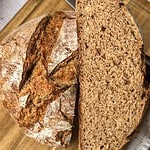
Mixed German Rye Bread (Mischbrot)
This Mixed German Rye Bread, also called Mischbrot, is a rustic sourdough loaf made with a combination of freshly milled rye flour and all-purpose flour. It has a hearty texture, a slightly tangy flavor, and a lovely crust that makes it great for everyday meals.
PIN THIS RECIPE!
Ingredients
For the rye sour (the night before)
- 110 g freshly milled rye flour
- 110 g warm water
- 20 g active sourdough starter your regular wheat starter works!
For the main dough
- 320 g all-purpose flour
- 110 g freshly milled rye flour
- 200 g whey or water don’t stress if you use water, I usually do! Whey is a nice addition when I have it from making yogurt, but not necessary at all!
- 70–90 g water
- 11 g salt
- 4 g caraway seeds optional
Instructions
- Prepare the rye sour. The night before baking, mix the rye flour, warm water, and sourdough starter - you should get a paste-like consistency, and that’s normal! Cover and leave at room temperature for 12–14 hours, until bubbly, active, and relatively sour.
- Mix the dough. Combine the rye sour with the remaining ingredients, starting with 70 g of water. Mix for about 5 minutes, and aim to have no dry flour left - that’s the standard we’re going for. If you see the dough is too dry for all the flour to be hydrated, add more water. This dough is supposed to be paste-like, almost like a sticky play dough..
- First rise (bulk ferment). Cover and let the dough rise in a warm spot for about 2–3 hours, until puffy and roughly 30–40% bigger. It doesn't need to double like regular wheat sourdough, but it should have a lot of small bubbles - using a glass bowl makes it really easy to see this.
- Shape. Turn the dough onto a generously floured counter and shape it into a round loaf. Use rye flour to help with the stickiness, and bring the edges together to create a ball of dough. Don’t handle it too much, since it’s normal for the dough to still be sticky. Just get it in a ball as best as you can and place the loaf into a well-floured (!!!) proofing basket.
- Second rise. Cover and let it rise for another 45–75 minutes, until slightly puffy. Meanwhile, preheat your Dutch oven to 475°F (245°C). Don't let the dough overproof, since we want some oven spring to help open the crust.
- Bake. Carefully flip the loaf onto parchment paper so the seam faces up. Do a score of your choice, but be prepared for this loaf to crack a bit uncontrollably too! Transfer it to the hot Dutch oven and bake covered for 15 minutes. Lower the temperature to 410°F (210°C), remove the lid, and bake for another 30–35 minutes, until deep brown and about 205–208°F (96–98°C) inside.
- Cool. Let the loaf cool completely, preferably a few hours, before slicing. Rye bread needs more time for the crumb to set properly, and cutting it too early can make it gummy.
Notes
I really recommend using a glass bowl to ferment this bread in (and making the rye sour!). It will make the fermentation bubbles easy to spot, since there won’t be very noticeable on the surface because of the nature of this dough.
Why make a rye sour? Rye contains more starch-breaking enzymes than wheat, and those enzymes can make the inside of your bread sticky or gummy if they're too active. The acidity developed during sourdough fermentation helps slow them down, giving the bread a better texture. Making a rye sour overnight also develops that traditional rye flavor. You don't need to maintain a separate rye starter; simply use a little of your regular wheat starter to make it.
Two types of Mischbrot. German mixed breads are generally divided into two categories: Weizenmischbrot contains more wheat than rye, while Roggenmischbrot contains more rye than wheat. This recipe is a Weizenmischbrot, with 60% wheat and 40% rye. It's lighter and milder than a rye-dominant loaf, making it a good everyday bread.
For a nicely cracked crust: Flour your proofing basket generously, especially where the seam will rest. When shaping, bring the dough together without completely sealing the seam, so it can open naturally during baking. Proof the dough seam-side down and bake seam-side up, without scoring. A properly proofed loaf and a thoroughly preheated Dutch oven will help create those rustic cracks.
Caraway seeds: Traditional in many German and Austrian breads, but completely optional. If you're baking with rye for the first time, try leaving them out to taste the rye on its own!
Whey or water: Leftover whey from homemade yogurt adds a little extra acidity and flavor, but water works just as well when you're using a properly fermented rye sour!
Freshly milled rye: Mill your rye as finely as possible. Different grains absorb water differently, so you may need to adjust the hydration slightly.
Tried this recipe?Please consider Leaving a Review!
Nutrition
Calories: 1196kcal | Carbohydrates: 250g | Protein: 34g | Fat: 4g | Saturated Fat: 1g | Polyunsaturated Fat: 1g | Monounsaturated Fat: 1g | Sodium: 4280mg | Potassium: 397mg | Fiber: 10g | Sugar: 1g | Vitamin A: 15IU | Vitamin C: 1mg | Calcium: 84mg | Iron: 16mg
