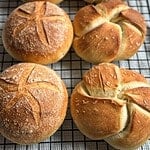
Sourdough Kaiser Rolls (Austrian Kaisersemmeln)
These Sourdough Kaiser Rolls are made with an active sourdough starter, all-purpose flour, butter, and a little sugar for flavorful bread rolls that are iconic for a reason. They have the classic Kaiser shape with a soft inside and brown just the right amount. The dough takes a little time to rise, but the ingredients are simple, and you have 2 options how to shape them!
PIN THIS RECIPE!
Ingredients
- 525 g all-purpose flour preferably 11–12% protein
- 290 g lukewarm water
- 150 g active sourdough starter 100% hydration, at or near peak
- 25 g unsalted butter softened
- 10 g sugar
- 12 g fine sea salt
- Some oil for brushing the rolls
Instructions
- Combine the water, sourdough starter, and sugar in a large mixing bowl. Add the flour, salt, and softened butter. Mix until combined, then knead by hand or with a stand mixer for approximately 8–10 minutes, until the dough is smooth, elastic, and slightly tacky. In the bowl of a stand mixer, it should just almost pull away from the sides of the bowl (but not quite) - if it’s far from it, add flour until it does!
- Transfer the dough to a bowl where you plan to bulk ferment it, cover, and let rise at room temperature until visibly it’s full of small bubbles and increased in volume by about 40%. This should take around 5–7 hours at 75–77°F (24–25°C), depending on your starter and room temperature.
- Turn the dough onto your counter and divide it into 6 pieces. Shape each piece into a ball, cover, and let rest for 15–20 minutes to relax the gluten.
- On an unfloured or lightly floured surface, roll each piece into a rope approximately 18–20 inches (45–50 cm) long. I like to do this in turns, so te gluten has time to relax. Meaning I’ll roll one rope a bit, then the next one, and the next, and then I’ll come back and roll the first one some more, and the next, and the next…On each rope, tie a loose knot in the center. Bring one free end over the loop and tuck it into the center, then wrap the other end underneath and up through the center. Tuck the ends securely to create the characteristic five-part Kaiser shape. See the video for this step!OPTIONAL: you can also just leave the dough balls as they are, and you’ll be scoring the signature kaiser roll design onto them later.Place the shaped rolls (or just rolls if you decided to score them instead of shape them) on a parchment-lined baking sheet, leaving enough space between them to rise.
- Lightly oil their tops (I like to use olive oil spray for this part! Alternatively, you can lightly brush them with oil too), cover with plastic wrap, and place a second baking sheet directly on top. Let its weight gently press down on the rolls as they rise, encouraging them to expand outward rather than upward.
- Let the rolls rise for about 2–4 hours, until noticeably puffy. Carefully remove the top baking sheet and plastic wrap.At the end of the second rise, If you decided not to shape the rolls, but score them, grab a bread lame or a sharp knife and draw the Kaiser roll design onto them.
- Preheat the oven to 425°F (220°C), placing a small empty metal baking pan on a lower rack for steam.Place the rolls in the oven and carefully pour some very hot water into the preheated metal pan.Bake for 10 minutes, then remove the steam pan, reduce the temperature to 410°F (210°C), and bake for another 10–15 minutes, until golden brown.Transfer to a wire rack and allow to cool before slicing.
Notes
Flour: All-purpose flour with 11–12% protein gives a very soft with enough structure to hold the Kaiser shape. You can also use bread flour, but it will give you a bit less soft, more chewy roll..
Shaping: These rolls are deliberately divided into six portions because the larger pieces are easier to roll and knot. When you make these a couple of times, you can try to make smaller ones!.
Alternative shaping: If you don't want to make the traditional knot, shape the dough into tight balls instead. After the second rise, use a sharp blade to score five curved cuts from the center outward, creating the Kaiser star.
Overnight option: After shaping, cover the rolls well and refrigerate for 8–12 hours instead of completing the second rise at room temperature. The following morning, let them finish proofing at room temperature if needed, until noticeably puffy, then bake as directed.
Tried this recipe?Please consider Leaving a Review!
Nutrition
Calories: 378kcal | Carbohydrates: 73g | Protein: 10g | Fat: 4g | Saturated Fat: 2g | Polyunsaturated Fat: 0.5g | Monounsaturated Fat: 1g | Trans Fat: 0.1g | Cholesterol: 9mg | Sodium: 778mg | Potassium: 95mg | Fiber: 3g | Sugar: 2g | Vitamin A: 104IU | Calcium: 15mg | Iron: 4mg
