
Why Cooking Feels So Complicated (And How to Simplify It)
At a glance: a few practical ideas that take cooking from overwhelming to manageable, without more recipes.
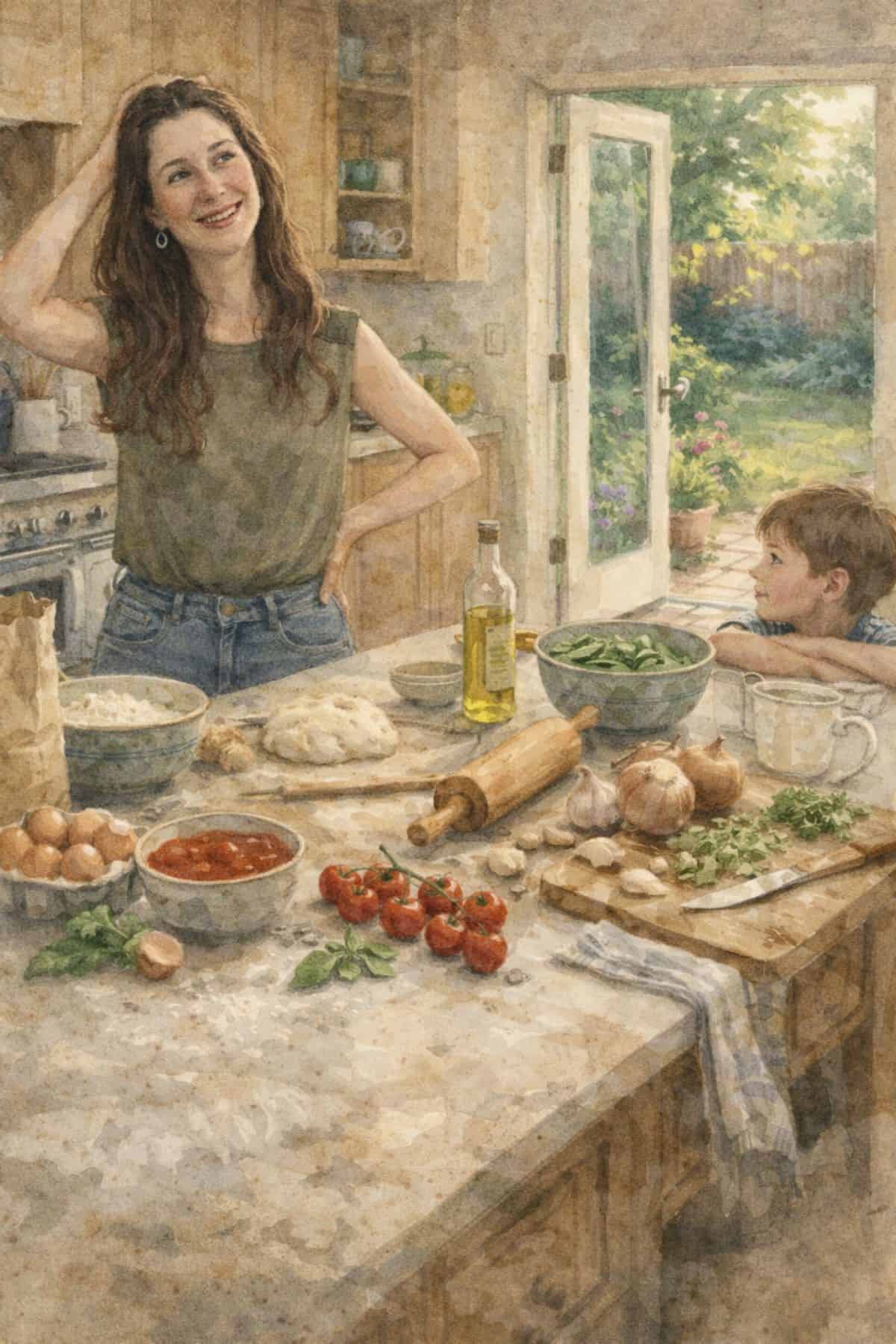
I have hundreds of recipes saved on my phone. From Facebook groups, random Instagram reels, YouTube videos… you name it.
And still, way too often, I find myself standing in my kitchen wondering what to cook and how to turn the ingredients I already have into actual meals.
Lately, I've been thinking a lot about why that is.
I'm lucky to still have both of my grandmothers, and I've almost made it my little mission to figure out what it is they know that I don't.
Not just recipes.
But all those small, almost invisible things they do without thinking. The way they approach food. The way they plan. The way they somehow always seem to have things figured out.
And the more I pay attention, the more I realize they don't necessarily know more recipes than me, or have more ingredients at home.
It's all about how they think in the kitchen.
So below, I gathered a few things that most people don't think about when they want to simplify their kitchen workflows, but were crucial to get mine in order.
Really knowing your ingredients
This is probably the biggest difference I've noticed.
My grandmothers don't just cook with random ingredients, they know everything they cook with and have extensive experience using every single one of them.
They know what each one does, how it behaves, and how to adjust without overthinking it.
I had a small moment like this recently while experimenting with buckwheat sourdough.
I kept trying to get a soft, fluffy loaf, but it always turned out dense and a bit tough. So I did what I usually do… started adjusting hydration, looking up ratios, trying to troubleshoot it like a formula.
Then I casually mentioned it to my mother-in-law.
And she asked me, "Did you scald the buckwheat flour first?"
I hadn't.
And the way she looked at me… like I skipped the most obvious step.
But of course she was right. Once I started doing that, everything changed!.
And once you have that, cooking (and baking especially!) becomes a lot more intuitive.

Join me on my YouTube channel ...
And see how that looks like in real life!
Subscribe to my
Don't fall for the marketing
We're surrounded by options now, and ... not all of them are good. We definitely don't even need half of them (at least that's what I've found).
Different flour blends for different purposes, special sauces for every type of dish, products that promise to make things easier, faster, better.
But if you really look at it, a lot of it is just the same ingredient… they're just packaged slightly differently.
Canned tomatoes become "pizza sauce" or "pasta sauce" depending on what's added to them.
But in reality, you can do the same thing yourself in seconds.
Add a bit of olive oil, some oregano, maybe garlic… and you're there.
You don't need a separate product for everything.
Most of the time, a few basic ingredients will take you much further than a pantry full of specialized ones.
Simple things get complicated online
This is something I've noticed over and over again, especially since I started hanging out in Facebook groups for sourdough and fresh milled flour.
Very simple, traditional skills… become very complicated the moment they go online.
Sourdough is a good example. Fresh-milled flour is another.
When I first started milling my own flour, I kept seeing advice that made it feel like I needed five different types of wheat berries just to get started.
And while there's some truth to that… you really don't need all of it.
Most of the time, I use hard white wheat. And sometimes spelt for softer bakes, but really, that's 90% of what I use.
I've made everything from bread to cake with just those. You can even use hard white for everything, I promise!
You don't need the perfect setup to get started, and not everything is rocket science.
You just need to start, and the confidence will follow.

Learn the skill… not just the recipe
This one took me a while to understand, because it's easy to learn how to make something once. In a very isolated kind of way.
But it's much more useful to learn everything you can do with it. A good example is sauerkraut.
Online, it's often described as something you make, put in a jar, and eat raw from the fridge.
And yes, that's one way to use it, but where I live, it's much more than that.
We cook with it, we make stews from it, we serve it as a side dish, we fry it with a bit of fat and season it well.
We use it in different meals throughout the week.
So in my mind, it's an ingredient, not just a finished product. And so many other things are like that!
The more ways you know how to use something, the more valuable it becomes as an ingredient.
Don't be afraid of repetition
This is something modern cooking often avoids, because it can be ... well, boring.
We're told to eat a wide variety of foods every single day.
But in reality, especially in older kitchens, meals were often built around what was available, and it was a lot of the same, served in different ways.
If something was in season, you ate it often, if it wasn't, you went without for a bit
No one was buying blueberries in the middle of winter (though I do admit I do that sometimes too!)
And honestly… that's okay.
Repetition is not the enemy, it's something you can embrace.

Lower your expectations (just a little)
This might be the most important one, because I too sometimes forget that food doesn't need to be exciting all the time.
Most of the time, it should just be simple, nourishing, and easy to prepare (at least that's what I'm striving for!)
There are so many opinions today about what "healthy eating" should look like, but we often forget that nutrition isn't just about the food itself.
It's also about how we feel while cooking it who are we preparing it with, and ost importantly, how we feel while eating it.
You can have the "perfect" meal on paper…
But if you're stressed, overwhelmed, and rushing through everything, it doesn't really feel healthy, does it?
Sometimes a simple meal, eaten calmly, is the better option.
A small shift that changes everything
The more I think about it, the more I realize this: my grandmothers didn't have more options, they actually had fewer.
But they used them better.
They knew their ingredients, they kept things simple, they didn't overthink every step.
And maybe that's what's missing for a lot of us, "modern" cooks. So again, not more recipes (I'm a broken record, I know), just a different way of approaching the kitchen.
Something a little more grounded, and a lot more practical.
And a lot less complicated!




Lots of great tips! Thank you for sharing your experiences and knowledge!!😊♥️
Thank you so much Lydia!